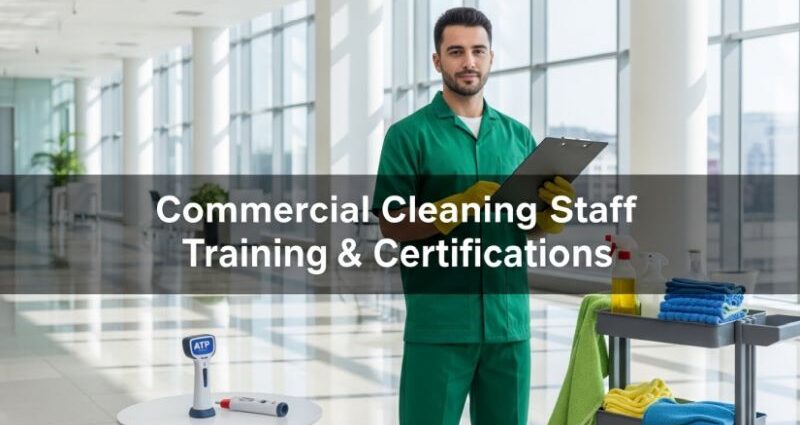
Not every cleaning crew understands the difference between sanitizing and disinfecting. Not every janitorial team knows how to read a Safety Data Sheet or respond to a bloodborne pathogen exposure. And not every commercial cleaning company invests in the professional training programs that separate true industry professionals from workers simply going through the motions.
For facility managers across the Inland Northwest, this distinction matters. When you hire a commercial cleaning service, you’re trusting them with your building’s reputation, your employees’ health, and your compliance with federal safety regulations. The question is: does your cleaning company have the certifications and training to back up that trust?
At ProTex Janitorial Services, Rich Greco has spent more than 30 years in the commercial cleaning industry, watching the profession grow from basic mop-and-bucket operations to a technically sophisticated field requiring ongoing education and skills verification.
“When I started in this business, you could learn on the job and figure things out as you went,” says Rich Greco, owner of ProTex Janitorial Services. “Today, our cleaners need to understand chemistry, infection control, safety regulations, and equipment operation at a professional level. The facilities we serve, from medical offices in Coeur d’Alene to industrial plants in Spokane, demand nothing less.”
This guide breaks down the training programs and certifications that define professional commercial cleaning, explains why these credentials matter for your facility, and helps you evaluate whether your current janitorial provider meets industry standards.
Key Takeaways
- ISSA CIMS certification represents the gold standard for commercial cleaning organizations, requiring documented management systems, quality controls, and continuous improvement processes
- OSHA training requirements for janitorial staff include Hazard Communication, bloodborne pathogen protocols, and personal protective equipment standards that protect both workers and building occupants
- IICRC carpet cleaning certification ensures technicians understand fiber identification, proper extraction methods, and stain removal chemistry beyond basic vacuuming
- Green Seal certification (GS-37 and GS-42) validates that cleaning companies use environmentally preferable products and follow sustainable practices without sacrificing performance
- Custodial technician certification through CMI provides frontline workers with industry-recognized credentials covering daily maintenance tasks, floor care, and restroom cleaning protocols
- ATP testing and verification allows trained cleaning professionals to objectively measure surface cleanliness and validate that disinfection protocols are working effectively
Why Professional Certifications
Protect Your Facility
Today, our cleaners need to understand chemistry, infection control, safety regulations, and equipment operation at a professional level. The facilities we serve demand nothing less.
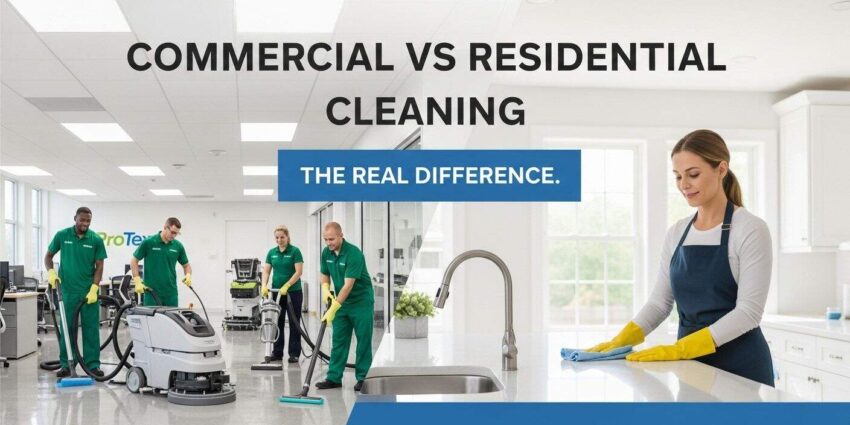
What Makes Commercial Cleaning Different From Residential Cleaning
Before discussing specific certifications, it’s important to understand why commercial cleaning requires specialized training that goes far beyond what residential cleaners need to know.
Commercial facilities present unique challenges:
- Higher traffic volumes mean faster soil accumulation and more frequent pathogen exposure
- Regulatory requirements under OSHA, EPA, and industry-specific standards create compliance obligations
- Specialized surfaces and equipment require technical knowledge of proper care methods
- Security and liability concerns demand background-checked, bonded staff who follow documented procedures
- Healthcare and food service facilities have strict infection control and sanitation requirements
A trained commercial cleaner understands that mopping a hospital corridor and mopping a home kitchen are fundamentally different tasks with different safety implications, chemical requirements, and documentation needs.
The International Sanitary Supply Association (ISSA) has established the framework for professional standards in the cleaning industry worldwide. Their certification programs, training curricula, and management standards form the foundation of credible commercial cleaning operations.
The ISSA Cleaning Industry Management Standard (CIMS)
The ISSA Cleaning Industry Management Standard, commonly known as CIMS, represents the industry’s most rigorous organizational certification. While individual technicians can earn various credentials, CIMS certifies that an entire cleaning organization has implemented systematic management practices.
What CIMS Certification Requires
CIMS evaluates cleaning organizations across five core elements:
- Quality Systems – Documented procedures for service delivery, quality inspection, and customer satisfaction measurement
- Service Delivery – Standardized cleaning protocols, training systems, and task verification processes
- Human Resources – Hiring practices, employee development programs, retention strategies, and safety training documentation
- Health, Safety, and Environmental Stewardship – OSHA compliance, hazard communication programs, and sustainable practices
- Management Commitment – Leadership involvement, continuous improvement processes, and resource allocation for quality
To achieve certification, organizations must meet 100% of mandatory elements and at least 60% of recommended elements in each section. An ISSA-accredited third-party assessor conducts on-site evaluations to verify that the cleaning operation follows documented systems and processes.
CIMS-GB: The Green Building Add-On
CIMS-GB certification adds environmental requirements to the base CIMS standard. Organizations earning CIMS-GB demonstrate:
- Use of environmentally preferable cleaning products meeting Green Seal or similar standards
- Sustainable practices aligned with LEED EB: O&M green building requirements
- Indoor air quality protection through low-VOC products and proper ventilation practices
- Waste reduction and recycling programs
For Spokane and Coeur d’Alene facility managers pursuing LEED certification for their buildings, working with a CIMS-GB certified cleaning provider helps earn points toward that goal.
Why CIMS Matters for Facility Managers
CIMS certification appears in many cleaning service bid specifications because it gives facility managers an objective way to evaluate potential vendors. Rather than relying solely on price comparisons or sales presentations, you can verify that a company has independently validated management systems.
Questions to ask prospective cleaning vendors about CIMS:
- Is your organization CIMS certified? At what level?
- When was your last assessment, and when is your next recertification due?
- How do you document and track quality metrics across client sites?
- Can you provide references from other CIMS-certified work you’ve performed?
The 5 Core Elements of CIMS Certification
What makes an organization truly certified for excellence
OSHA Training Requirements for Janitorial Staff
The Occupational Safety and Health Administration (OSHA) sets mandatory training requirements for workers who face specific workplace hazards. For commercial cleaning staff, several OSHA standards apply directly.
Hazard Communication Standard (HazCom)
OSHA’s Hazard Communication Standard, codified at 29 CFR 1910.1200, requires that all employees who work with hazardous chemicals receive training on:
- Safety Data Sheets (SDS) – How to read and interpret the 16-section format that provides hazard information for every chemical
- Container labeling – Understanding signal words, pictograms, and hazard statements
- Protective measures – Proper use of personal protective equipment when handling chemicals
- Emergency procedures – What to do in case of spills, exposures, or other chemical incidents
For janitorial services, this means every cleaner must understand the chemicals they use daily. Even common products like glass cleaners, floor strippers, and disinfectants have specific handling requirements documented in their SDS.
Proper chemical handling training covers:
- Dilution ratios and why they matter for both safety and effectiveness
- Dwell time requirements for disinfectants to achieve claimed kill rates
- Incompatible chemical combinations to avoid (never mix bleach and ammonia, for example)
- Storage requirements to prevent degradation or dangerous reactions
- Personal protective equipment selection based on chemical hazards
Bloodborne Pathogens Standard
OSHA’s Bloodborne Pathogen Standard (29 CFR 1910.1030) requires training for any employee who may encounter blood or other potentially infectious materials in their work. This includes:
- Healthcare facility cleaning staff who handle regulated medical waste
- School custodians who may clean up after student injuries
- Office building janitors who might encounter contaminated sharps or bodily fluids
- Industrial cleaning crews in facilities with occupational injury potential
BBP training must cover:
- Routes of transmission for bloodborne pathogens including HIV, Hepatitis B, and Hepatitis C
- Engineering controls like sharps containers and biohazard bags
- Work practice controls for handling contaminated materials
- Proper selection and use of personal protective equipment
- Emergency procedures for exposure incidents
- Hepatitis B vaccination availability
Training must occur before job assignment and annually thereafter. OSHA requires that training be provided in a language and format employees can understand, with opportunity for questions.
Personal Protective Equipment Standard
Beyond chemical-specific requirements, OSHA’s PPE standard (29 CFR 1910.132) requires employers to:
- Conduct hazard assessments to determine what PPE is needed
- Provide appropriate PPE at no cost to workers
- Train employees on proper use, maintenance, and limitations of each type of PPE
For commercial cleaners, PPE training typically includes:
- Gloves – Selection based on chemical compatibility, proper donning and doffing techniques, and when to replace damaged gloves
- Eye protection – Safety glasses, goggles, or face shields depending on splash hazards
- Respiratory protection – When N95 masks or respirators are required and how to perform seal checks
- Footwear – Non-slip shoes or boots appropriate for wet floor hazards
Slip, Trip, and Fall Prevention
While not a separate OSHA standard, fall prevention represents one of the most common injury risks for cleaning staff. Training programs should address:
- Wet floor signage placement and timing
- Proper techniques for wringing mops and controlling water on floors
- Ladder safety for high-dusting and light fixture cleaning
- Cord management to prevent trip hazards from vacuum and buffer cords
- Ergonomic techniques for pushing carts and lifting supplies
According to the Bureau of Labor Statistics, janitorial workers experience injury rates of approximately 2.4 per 100 full-time workers. Proper training significantly reduces these incidents.
Lockout/Tagout Awareness
Cleaning staff working in industrial or manufacturing environments need awareness training for lockout/tagout procedures (29 CFR 1910.147). While cleaners typically don’t perform equipment servicing requiring full lockout procedures, they must understand:
- How to recognize when equipment is locked out
- Why never to remove or bypass lockout devices
- Which areas to avoid when maintenance is occurring
- When to notify supervisors about potential hazards
- Emergency procedures if accidentally trapped near equipment
Respiratory Protection
Some cleaning situations require respiratory protection beyond standard surgical masks:
- Using strong chemicals in poorly ventilated spaces
- Stripping floors with solvent-based products
- Cleaning areas with mold contamination
- Working during construction or renovation dust
- Applying pesticides or dealing with pest infestations
OSHA’s Respiratory Protection Standard (29 CFR 1910.134) requires medical evaluation, fit testing, and training before workers use tight-fitting respirators. Cleaning companies serving industrial facilities often maintain respiratory protection programs for these situations.
OSHA Training Requirements for Janitorial Staff
- Safety Data Sheet (SDS) interpretation
- Container labeling requirements
- Chemical hazard recognition
- PPE selection for chemicals
- Spill response procedures
- Transmission route awareness
- Engineering controls (sharps containers)
- PPE donning/doffing procedures
- Hepatitis B vaccination rights
- Exposure incident response
- Hazard assessment awareness
- Glove selection by chemical type
- Eye/face protection requirements
- Respiratory protection basics
- Non-slip footwear standards
- Wet floor signage protocols
- Ladder safety procedures
- Cord management techniques
- Ergonomic lifting methods
- Hazard recognition skills
Important: Training must be provided in a language and format employees understand, with opportunity for questions.
Industry-Specific Certifications
Beyond OSHA compliance, several industry organizations offer certifications that validate specialized knowledge in commercial cleaning disciplines.
IICRC Certifications for Carpet and Floor Care
The Institute of Inspection, Cleaning and Restoration Certification (IICRC) offers the most widely recognized credentials for commercial carpet cleaning technicians.
Carpet Cleaning Technician (CCT) certification teaches:
- Fiber identification and how different fiber types respond to cleaning methods
- Yarn construction and carpet styles that affect cleaning approaches
- Soiling conditions and the chemistry of stain removal
- Cleaning science including pH, surfactants, and soil suspension
- Equipment operation for portable extractors and truck-mounted units
- Pre-inspection procedures to identify potential problems before cleaning
IICRC certification requires passing a proctored exam after completing approved coursework. Certified technicians must earn continuing education credits every four years to maintain their credentials.
Why IICRC certification matters: Improper carpet cleaning can cause permanent damage including fiber distortion, color bleeding, and backing delamination. Certified technicians understand how to evaluate each carpet before selecting a cleaning method, whether that’s hot water extraction, encapsulation, or bonnet cleaning.
Additional IICRC certifications relevant to commercial cleaning include:
- Commercial Carpet Maintenance Technician (CCMT) – Focuses on interim maintenance programs for commercial facilities
- Floor Care Technician (FCT) – Covers hard surface floor cleaning and maintenance
- Upholstery and Fabric Cleaning Technician (UFT) – Addresses fabric identification and upholstery care
CMI Custodial Technician Certification
The Cleaning Management Institute (CMI), a division of ISSA, offers the most widely recognized certification program for frontline custodial workers. Established in 1964, CMI has certified more than 250,000 individuals worldwide.
Basic Level certification covers six modules:
- Customer Service – Professional conduct, communication skills, and handling client interactions
- Chemistry of Cleaning – Understanding pH levels, soil types, chemical reactions, and proper product selection
- Hard Floor Cleaning – Sweeping, mopping, scrubbing, and maintaining various hard floor surfaces including VCT, LVT, concrete, and terrazzo
- Carpeted Floor Cleaning – Vacuuming techniques, spot removal, interim maintenance, and extraction fundamentals
- Above-Floor Surface Cleaning – Procedures for glass, stainless steel, wood, plastic, and fabric surfaces
- Restroom and Shower Room Cleaning – Sanitation protocols, fixture care, and hygiene standards
Advanced Level certification builds on basic skills with three additional modules:
- Floor Stripping and Refinishing – Complete procedures for removing old finish, preparing surfaces, and applying new floor finish coats
- Spray Buffing and Burnishing – Techniques for maintaining floor appearance between full strip cycles
- Carpet Extraction and Restoration – Deep cleaning methods for heavily soiled or damaged carpet
Each certification level requires passing a proctored exam with a minimum 80% score. Certifications remain valid for two years before requiring recertification.
CMI certification validates that cleaners understand not just how to perform tasks, but why specific procedures matter. A certified technician knows why you mop in a figure-eight pattern to prevent re-depositing soil, why disinfectants need specific contact times to achieve their claimed kill rates, and why certain chemicals should never be mixed.
“I look for CMI certification when hiring new team members,” Rich Greco explains. “It tells me they’ve invested in learning their profession and they’ll understand why we follow the procedures we do. You can teach someone a specific task, but the foundation CMI provides makes everything else easier.”
CMI Custodial Supervisor Certification
Beyond technician-level credentials, CMI offers Custodial Supervisor Certification for those managing cleaning teams. This program addresses:
- Leadership Development – Communication skills, conflict resolution, and team motivation
- Purchasing and Inventory Management – Product selection, vendor relations, and cost control
- Hiring and Training – Recruiting practices, onboarding procedures, and performance management
- Quality Assurance – Inspection methods, corrective action processes, and continuous improvement
- Scheduling and Workloading – Calculating labor requirements and optimizing cleaning frequencies
CMI Train-the-Trainer Certification
Cleaning organizations committed to internal training programs can pursue CMI Train-the-Trainer (TTT) certification. This three-day program equips designated trainers with skills to deliver CMI curriculum effectively within their organizations. TTT certification meets requirements for organizations pursuing CIMS certification, which requires documented training systems.
GBAC STAR Facility Accreditation
The Global Biorisk Advisory Council (GBAC), another ISSA division, offers facility-level accreditation for outbreak prevention and response programs.
GBAC STAR accreditation validates that a facility has:
- Established thorough cleaning and disinfection protocols
- Implemented proper work practices and standard operating procedures
- Trained staff in biorisk prevention and containment
- Developed emergency preparedness and response plans
While GBAC STAR is a facility accreditation rather than a cleaning company certification, many commercial cleaning providers employ GBAC-trained technicians who can support client facilities pursuing this accreditation.
The GBAC STAR program gained significant visibility during the COVID-19 pandemic when facilities of all types, from airports to convention centers to office buildings, sought third-party validation of their cleaning protocols.
Commercial Cleaning Certifications at a Glance
Compare industry credentials and what they validate
*Specific OSHA topics (BBP, HazCom) require annual refresher training
Green Cleaning Certifications
Environmental concerns increasingly influence purchasing decisions for commercial cleaning services. Several certification programs validate green cleaning practices.
Green Seal Standards for Cleaning
Green Seal is a nonprofit organization that sets leadership standards for environmentally preferable products and services. Their cleaning-related standards include:
GS-37: Cleaning Products for Industrial and Institutional Use
This standard covers commercial cleaning chemicals including:
- All-purpose cleaners and degreasers
- Bathroom cleaners and disinfectants
- Glass cleaners
- Carpet cleaners
- Floor care products
Products meeting GS-37 requirements must demonstrate:
- Human health safety with restricted ingredients including carcinogens, reproductive toxicants, and asthmagens
- Environmental safety including biodegradability and aquatic toxicity limits
- Product performance meeting or exceeding conventional alternatives
- Concentrated formulas to reduce packaging waste
- Clear and accurate labeling
GS-42: Commercial and Institutional Cleaning Services
This standard certifies cleaning service providers, not just products. GS-42 certified cleaning companies must:
- Use environmentally preferable cleaning products meeting Green Seal or equivalent standards
- Implement sustainable practices for waste reduction and resource conservation
- Train staff on proper product dilution and equipment maintenance
- Document and track environmental performance metrics
- Communicate environmental practices to clients
For facility managers pursuing green building certifications or responding to tenant demands for healthier indoor environments, Green Seal certified products and services provide objective verification.
Indoor Air Quality and Green Cleaning
Green cleaning certifications address indoor air quality concerns that affect building occupant health:
- Volatile organic compound (VOC) limits restrict chemicals that off-gas into indoor air
- Fragrance restrictions protect occupants sensitive to synthetic scents
- HEPA filtration requirements for vacuums capture fine particles rather than redistributing them
- Microfiber systems reduce chemical and water usage while improving soil removal
The connection between cleaning practices and indoor air quality becomes especially important in facilities serving vulnerable populations. Medical offices, schools, and senior living facilities all benefit from cleaning approaches that remove contaminants without introducing new air quality concerns.
Specialized Training for Different Facility Types
Beyond general certifications, professional commercial cleaners receive specialized training for the facility types they serve. Different environments present unique challenges requiring targeted knowledge and skills.
Healthcare Environmental Services Training
Medical office cleaning requires understanding of infection prevention principles that go beyond standard commercial cleaning:
- Terminal cleaning procedures for patient rooms after discharge, including systematic approaches to ensure no surfaces are missed
- High-touch surface disinfection for door handles, light switches, bed rails, call buttons, and other frequently contacted areas
- Isolation room protocols including proper PPE donning and doffing sequences, airborne infection isolation requirements, and contact precaution procedures
- HIPAA awareness for protecting patient privacy during cleaning activities, including handling of documents, charts, and computer screens
- Sharps safety for proper handling of encountered needles, scalpels, or other medical sharps
- Regulated medical waste handling including red bag procedures and sharps container management
Healthcare cleaning staff must understand the chain of infection and how proper cleaning breaks that chain. The six links include:
- Infectious agent (pathogen)
- Reservoir (where pathogens live and multiply)
- Portal of exit (how pathogens leave the reservoir)
- Mode of transmission (how pathogens travel)
- Portal of entry (how pathogens enter new hosts)
- Susceptible host (person who can become infected)
Effective environmental cleaning breaks the chain at multiple points, particularly by eliminating reservoirs and interrupting transmission.
Healthcare environmental services professionals should understand the difference between:
- Cleaning – Physical removal of soil and organic matter
- Sanitizing – Reducing microorganisms to safe levels
- Disinfecting – Eliminating most pathogenic microorganisms
- Sterilizing – Destroying all forms of microbial life (typically not achievable through cleaning)
Food Service Cleaning Protocols
Food service facilities require cleaners trained in:
- Food-safe cleaning products that don’t leave residues affecting food safety or taste
- Three-compartment sink procedures for manual warewashing
- Sanitization requirements for food contact surfaces including proper sanitizer concentration testing
- Pest prevention through proper waste handling, crack sealing, and elimination of food sources
- Health department compliance including documentation requirements and inspection preparation
- Allergen cross-contamination prevention through dedicated equipment and systematic cleaning sequences
- Grease trap and hood cleaning coordination with specialized contractors
- Walk-in cooler and freezer cleaning using appropriate cold-temperature procedures
Food service cleaning staff should understand the FDA Food Code and how cleaning practices support compliance with health regulations.
Industrial Facility Safety Training
Industrial and manufacturing facilities present unique hazards requiring specialized safety training:
- Lockout/tagout awareness for cleaning near machinery, including recognition of energy isolation devices
- Hazardous material handling beyond typical cleaning chemicals, potentially including exposure to manufacturing process chemicals
- Confined space awareness for tank cleaning, silo entry, or work in enclosed areas with potential atmospheric hazards
- Noise exposure and hearing protection requirements in loud manufacturing environments
- Hot work permit procedures when cleaning near welding, cutting, or other ignition sources
- Forklift traffic awareness and pedestrian safety in facilities with mobile equipment
- Spill response procedures for manufacturing chemicals beyond standard cleaning products
- Machine guarding awareness to avoid injury from moving equipment parts
Warehouse cleaning combines industrial safety concerns with large-scale floor care requirements, requiring understanding of powered equipment operation and efficient large-area cleaning techniques.
Educational Facility Requirements
Schools and daycares require cleaners who understand:
- Child-safe cleaning products with lower toxicity profiles appropriate for areas where children play and learn
- After-hours security protocols and background check requirements for school access
- Age-appropriate restroom cleaning for different grade levels, from elementary to high school
- Playground equipment and gymnasium surface care including rubber flooring and athletic court maintenance
- Food allergy awareness for cafeteria and classroom cleaning, particularly regarding peanut and tree nut contamination
- Art supply and science lab cleanup including proper handling of paints, chemicals, and biological materials
- Special education considerations for cleaning spaces used by students with specific health conditions
- Summer deep cleaning programs coordinating extensive cleaning during school breaks
Retail Space Cleaning
Retail stores present high-visibility cleaning challenges:
- Customer-facing cleaning during business hours without disrupting shopping
- Fitting room hygiene for clothing retailers
- Display and merchandise dusting without damaging products
- Entrance mat and vestibule maintenance managing tracked-in soil
- Window and glass storefront care
- Food court and restroom heavy-use management for retail centers
- Loss prevention awareness and working around security systems
Training Requirements by Facility Type
Different environments demand different expertise
Equipment and Technology Training
Modern commercial cleaning involves sophisticated equipment that requires proper training for safe, effective operation.
Floor Care Equipment
Auto-scrubbers have become essential for efficient hard floor cleaning in commercial facilities:
- Walk-behind scrubbers for medium-sized areas require training on solution dispensing rates, pad selection, squeegee adjustment, and battery maintenance
- Ride-on scrubbers for large facilities add operational controls, turning techniques, and obstacle avoidance skills
- Battery care and charging procedures extend equipment life and ensure consistent performance
Floor machines and buffers require technique training:
- Burnishing for high-speed polishing requires understanding of floor finish compatibility and proper pad progression
- Stripping involves chemical application, machine control on wet floors, and pickup techniques
- Spray buffing combines solution application with buffing for interim floor maintenance
Vacuum and Air Quality Equipment
HEPA-filtered vacuums capture fine particles that standard vacuums recirculate:
- Filter maintenance and replacement schedules
- Bag change procedures that minimize dust release
- HEPA certification verification for healthcare and cleanroom applications
Backpack vacuums improve productivity but require ergonomic training:
- Proper harness adjustment to distribute weight
- Movement techniques that minimize strain
- Battery management for cordless units
Microfiber Cleaning Systems
Microfiber technology has transformed commercial cleaning effectiveness:
- Color-coded cloths and mops prevent cross-contamination between areas
- Flat mop systems use less water and chemical while improving soil removal
- Proper laundering procedures maintain microfiber effectiveness over hundreds of wash cycles
- Microfiber limitations including when traditional materials remain appropriate
Training covers the science behind microfiber effectiveness: split fibers create millions of tiny hooks that grab and hold particles rather than pushing them around.
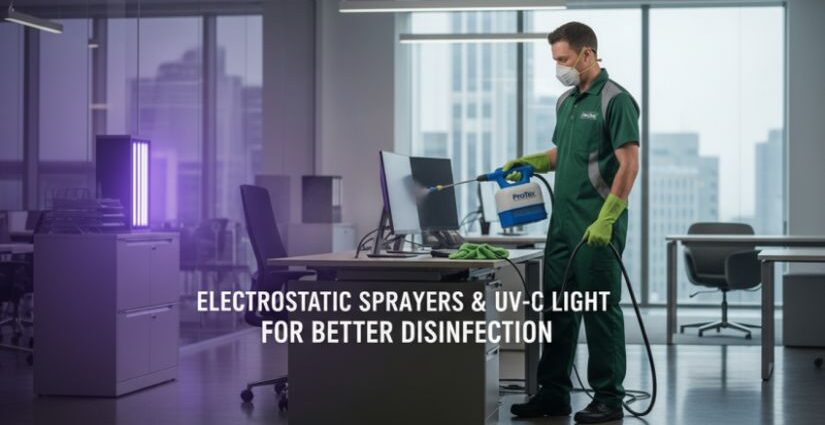
Electrostatic Sprayers and Disinfection Equipment
Advanced disinfection tools require specialized training:
- Electrostatic sprayer operation including charging mechanisms and coverage patterns
- Proper chemical selection for electrostatic application
- Dwell time requirements that apply equally to electrostatic and manual application
- UV-C disinfection devices including safety protocols and exposure timing
- Fogging and misting systems for whole-room treatment
Cleaning Management Software
Many commercial cleaning operations now use technology for:
- Work order management tracking tasks and completion
- Time and attendance documentation
- Quality inspection digital checklists and photo documentation
- Supply inventory monitoring and reorder automation
- Client communication portals and reporting
Training staff to use these systems effectively improves accountability and communication.
Quality Verification and Documentation
Trained commercial cleaners don’t just perform tasks. They verify their work meets standards and document their activities for accountability.
ATP Testing for Cleanliness Verification
Adenosine triphosphate (ATP) testing provides objective measurement of surface cleanliness that goes beyond visual inspection. ATP is present in all living cells, so measuring ATP levels indicates the presence of organic matter including bacteria, food residue, and other biological materials.
The ATP testing process:
- Swab a standard surface area (typically 10cm x 10cm)
- Insert swab into luminometer device
- Chemical reaction produces light proportional to ATP present
- Result displays in Relative Light Units (RLU)
- Compare result against established pass/fail thresholds
Trained cleaning professionals use ATP testing to:
- Verify cleaning effectiveness after completing disinfection protocols
- Identify problem areas that need additional attention
- Document compliance for quality assurance programs
- Train new staff by showing before/after results
- Calibrate cleaning frequencies based on measured contamination rates
ATP testing doesn’t identify specific organisms or indicate sterility, but it provides rapid, objective feedback that visual inspection cannot. A surface can look clean while still harboring significant biological contamination.
Inspection Checklists and Quality Control
Professional cleaning operations use documented inspection checklists to verify work quality:
- Task completion verification confirms all assigned areas were addressed
- Quality scoring systems rate cleaning results against defined standards
- Photographic documentation provides visual record of conditions
- Client communication logs track feedback and service adjustments
- Corrective action procedures address identified deficiencies
The APPA Custodial Appearance Levels provide industry-standard benchmarks for cleanliness:
- Level 1 (Orderly Spotlessness): Showroom condition, typically achievable only with extraordinary effort
- Level 2 (Ordinary Tidiness): Fresh, clean appearance with minor dust accumulation acceptable
- Level 3 (Casual Inattention): Generally acceptable for most commercial spaces
- Level 4 (Moderate Dinginess): Some visible soil and wear, budget-constrained cleaning
- Level 5 (Unkempt Neglect): Obvious cleaning deficiencies, unacceptable for most facilities
Most commercial facilities target Level 2-3 cleanliness, with high-visibility areas like lobbies and restrooms maintained at Level 2 and back-of-house areas acceptable at Level 3.
ATP Testing: How Professionals Verify Cleanliness
Beyond visual inspection to measurable results
*Thresholds vary by facility type and surface. Each operation establishes baselines based on their specific requirements.
The Training Investment: Why It Matters for Your Facility
Investing in trained, certified commercial cleaners provides measurable returns for facility managers. Research consistently shows that companies with strong training programs outperform those without structured development.
The Cost of Inadequate Training
According to Gallup research, approximately 40% of employees who receive poor job training leave their positions within the first year. In the commercial cleaning industry, where turnover already runs high, inadequate training accelerates the revolving door.
The real costs of untrained cleaning staff include:
- Hiring costs averaging $1,500 to $4,000 per replacement worker
- Productivity losses during the learning curve period
- Supervision time required to correct mistakes
- Customer complaints and potential contract losses
- Damage claims from improper equipment or chemical use
Companies with strong training programs report 218% higher revenue per employee than those without, according to Association for Talent Development research.
Reduced Liability Exposure
Properly trained cleaners:
- Follow documented procedures that demonstrate reasonable care
- Use chemicals according to manufacturer specifications
- Employ appropriate safety measures that protect building occupants
- Create records that support defense against claims
- Recognize hazards before incidents occur
When incidents occur, having evidence that your cleaning provider followed industry-standard training protocols strengthens your position. Training documentation becomes critical evidence in liability disputes.
Improved Cleaning Outcomes
Training translates directly to results:
- Correct chemical dilution ensures products work as intended without wasting money on over-concentrated solutions or achieving substandard results from under-diluted mixtures
- Proper technique removes more soil with less effort, improving both quality and efficiency
- Equipment knowledge extends the life of expensive machines while improving performance
- Surface-specific expertise prevents damage from inappropriate cleaning methods
- Time management allows completing more work without sacrificing quality
Research indicates that training can improve cleaning productivity by 20% or more through technique refinement and efficient work practices.
Lower Total Cost of Ownership
The cheapest cleaning bid often becomes expensive when problems emerge:
- Damaged flooring from improper stripping or buffing techniques requiring expensive restoration
- Carpet warranty voided by unqualified cleaning methods, leaving you responsible for early replacement
- Equipment breakdowns from untrained operators who skip maintenance or abuse machines
- Regulatory fines for safety violations that proper training would have prevented
- Tenant complaints requiring rework that should have been unnecessary
“I’ve seen facilities switch to cheaper providers and end up spending twice as much fixing the damage,” Rich Greco notes. “A trained professional might cost more per hour, but they get the job done right the first time and protect your assets in the process. One improper floor stripping job can cost more than a year of professional service.”
Enhanced Building Health
Trained cleaners understand the connection between cleaning practices and occupant health:
- Proper disinfection reduces infection transmission and absenteeism
- Dust and allergen control improves air quality for sensitive occupants
- Chemical safety prevents occupant exposures that cause complaints
- Restroom hygiene protects public health and facility reputation
The hidden costs of poor cleanliness include increased sick days, reduced productivity, and damaged reputation with clients and visitors. Studies suggest that improved cleaning can reduce absenteeism by 46% in some environments.
Employee Retention Benefits
Training investment signals organizational commitment to workers:
- 94% of employees say they would stay longer at companies that invest in their learning
- Trained workers report higher job satisfaction and engagement
- Career development pathways reduce turnover by showing advancement opportunities
- Cross-training creates versatile teams that handle absences without service disruption
The ROI of Professional Training
Why investing in certified cleaners pays dividends
I’ve seen facilities switch to cheaper providers and end up spending twice as much fixing the damage. A trained professional might cost more per hour, but they get the job done right the first time.
How to Evaluate Your Cleaning Provider’s Training
When assessing current or prospective janitorial services, ask these questions:
Organizational Credentials
- Is your company CIMS certified? At what level?
- Do you hold Green Seal GS-42 certification?
- What third-party assessments has your organization completed?
- How do you document and maintain organizational certifications?
Staff Training Programs
- What training do new hires receive before starting assignments?
- How many hours of initial training does each cleaner complete?
- What ongoing training requirements do you maintain?
- How do you verify that training was effective?
Individual Certifications
- Do your technicians hold CMI Custodial Technician certification?
- Are carpet cleaning technicians IICRC certified?
- Have staff completed OSHA-required safety training?
- Do healthcare facility cleaners have specialized training?
Documentation and Verification
- Can you provide training records for staff assigned to our facility?
- What quality inspection processes do you use?
- Do you perform ATP testing or other objective verification?
- How do you document and respond to quality issues?
Red Flags to Watch For
Be cautious of cleaning providers who:
- Cannot provide documentation of training programs
- Rely entirely on on-the-job training without structured curricula
- Have no quality inspection process beyond client complaints
- Cannot explain their chemical selection rationale
- Don’t mention safety training as part of their program
Regional Training Considerations for the Inland Northwest
Cleaning professionals serving Spokane, Coeur d’Alene, and surrounding communities face region-specific challenges that training should address:
Seasonal Variations
The Inland Northwest’s four distinct seasons create changing cleaning demands:
- Winter brings tracked-in salt, sand, and slush requiring enhanced entrance mat programs and floor protection
- Spring introduces pollen and allergen concerns affecting indoor air quality
- Summer construction season creates dust control challenges
- Fall means leaf debris and preparation for heating season
Trained cleaners adjust their approaches seasonally rather than following identical procedures year-round. Seasonal cleaning checklists help ensure nothing gets overlooked.
Local Industry Knowledge
Understanding local industries helps cleaners anticipate facility needs:
- Medical facilities near regional hospitals require healthcare-grade training
- Manufacturing operations along I-90 need industrial safety expertise
- Government buildings require security clearance awareness
- Retail spaces in downtown districts need high-traffic floor care skills
Weather-Related Challenges
The region’s climate creates specific cleaning considerations:
- Hard water affects chemical effectiveness and leaves mineral deposits
- Pine pitch from abundant trees requires specialized removal techniques
- Wildfire smoke during summer creates air quality concerns
- Freeze-thaw cycles damage exterior surfaces and create interior moisture problems
Building Your Facility’s Cleaning Standards
Rather than simply accepting whatever training your cleaning provider offers, facility managers can establish expectations that ensure qualified service.
Include Training Requirements in Contracts
Specify minimum training requirements in your cleaning service agreements:
- Required certifications for assigned staff
- Ongoing training hours per employee per year
- Documentation to be provided upon request
- Consequences for non-compliance
Request Proof of Qualifications
Before signing contracts or annually thereafter:
- Review copies of relevant certifications
- Verify certifications are current and valid
- Confirm that assigned staff hold required credentials
- Document verification in your records
Conduct Your Own Quality Verification
Supplement provider quality control with your own checks:
- Walk through facilities periodically with inspection checklists
- Track complaint frequency and resolution time
- Consider third-party cleaning audits annually
- Use ATP testing to verify disinfection claims
Partner Rather Than Police
The best relationships with cleaning providers involve collaborative quality improvement:
- Share feedback constructively and promptly
- Recognize excellent performance
- Discuss challenges and seek solutions together
- Support training investments that benefit your facility
“The facilities where we do our best work are the ones where the manager sees us as partners,” says Rich Greco. “When they tell us what’s working and what isn’t, we can adjust. When they just wait until something goes wrong to complain, everyone loses.”
The ProTex Approach to Training and Certification
At ProTex Janitorial Services, we believe professional credentials reflect professional commitment. Our approach includes:
Structured Onboarding Program
Every new team member completes documented training covering:
- Safety orientation including OSHA-required elements
- Chemical handling and SDS interpretation
- Equipment operation and maintenance
- Facility-specific procedures for their assignments
- Customer service standards and communication protocols
Ongoing Professional Development
Training doesn’t end after onboarding:
- Regular safety refreshers and updates
- Skill-building sessions on advanced techniques
- Cross-training opportunities for career advancement
- Industry certification support and encouragement
Quality Verification Systems
We verify that training translates to results:
- Regular supervisor inspections using standardized checklists
- Client feedback collection and response
- Objective testing where appropriate
- Continuous improvement based on performance data
Regional Expertise
Serving the Inland Northwest for over three decades has given us deep understanding of local conditions:
- Seasonal challenges from Sandpoint to Spokane Valley
- Industry-specific needs across North Idaho and Eastern Washington
- Relationships with local suppliers and service providers
- Understanding of regional regulations and expectations
Frequently Asked Questions
What certifications should a commercial cleaning company have?
Look for ISSA CIMS certification at the organizational level, which validates management systems, quality controls, and training programs. Individual technicians should hold CMI Custodial Technician certification for general cleaning and IICRC credentials for specialized carpet and floor care. OSHA safety training documentation should be available for all staff. Green Seal GS-42 certification indicates commitment to environmentally preferable practices.
How often should cleaning staff receive training updates?
OSHA requires annual refresher training for bloodborne pathogen and hazard communication standards. Industry best practices recommend ongoing training of at least eight to twelve hours annually covering new techniques, equipment updates, and quality improvement. IICRC certified technicians must earn continuing education credits every four years to maintain credentials. High-performing cleaning organizations provide monthly or quarterly skill-building sessions.
What is the difference between CIMS and CIMS-GB certification?
CIMS (Cleaning Industry Management Standard) certifies that a cleaning organization has implemented systematic management practices covering quality systems, service delivery, human resources, health and safety, and management commitment. CIMS-GB adds environmental requirements including use of Green Seal certified products, sustainable practices aligned with LEED certification, and documented green cleaning programs. Both require third-party assessment and periodic recertification.
Why does bloodborne pathogen training matter for office cleaners?
Office building cleaners may encounter blood or bodily fluids from workplace injuries, restroom incidents, or improperly discarded personal items. OSHA requires employers to assess exposure potential and provide appropriate training. Even when exposure risk seems low, trained cleaners know how to recognize hazards, use proper protective equipment, and respond appropriately to unexpected situations without putting themselves or building occupants at risk.
How can ATP testing verify cleaning quality?
ATP (adenosine triphosphate) testing uses bioluminescence to measure organic matter on surfaces. A swab collects samples from a defined area, and a luminometer produces results in Relative Light Units within seconds. Lower readings indicate cleaner surfaces. Trained professionals establish baseline measurements and pass/fail thresholds for different surface types, then use testing to verify that cleaning protocols achieve expected results.
What training do medical office cleaners need beyond standard certification?
Medical office cleaning requires additional training in terminal cleaning procedures, high-touch surface disinfection protocols, isolation room handling, proper PPE sequencing, sharps safety, and HIPAA awareness. Staff should understand healthcare-associated infection prevention and how cleaning practices break the chain of infection. Some facilities require specific healthcare environmental services certification or training aligned with CDC guidelines.
Does green cleaning certification mean products are less effective?
No. Green Seal and similar certifications require products to demonstrate performance equal to or better than conventional alternatives as part of the certification process. Green certified products must meet efficacy requirements for their intended uses while also meeting human health and environmental safety criteria. Trained cleaners know how to use green products properly, including correct dilution ratios and contact times that ensure effectiveness.
How do I verify that my cleaning provider’s staff are actually certified?
Request copies of certifications and verify them with issuing organizations. CMI maintains records of certified custodial technicians, IICRC has a technician locator database, and CIMS publishes a directory of certified organizations. Reputable cleaning providers willingly share documentation and can identify which specific certifications each assigned staff member holds.
What happens when cleaning staff aren’t properly trained?
Untrained cleaners cause problems including damaged surfaces from improper chemical or equipment use, voided warranties from incorrect carpet cleaning methods, regulatory citations for safety violations, inconsistent results that generate complaints, increased occupant illness from inadequate disinfection, and liability exposure when incidents occur. The apparent savings from using untrained workers typically cost more than professional service in the long run.
How does training reduce cleaning costs?
Trained cleaners use chemicals at correct dilution ratios rather than wasting concentrated products. They operate equipment properly, extending machine life and reducing repair costs. They complete tasks efficiently using proven techniques rather than trial and error. They prevent damage that requires expensive remediation. They maintain consistent quality that avoids rework. Studies show companies with strong training programs achieve significantly higher productivity and lower turnover than those without structured development.
Take the Next Step
Your facility deserves cleaning professionals who understand their work at a technical level, not just workers going through motions. Trained, certified commercial cleaners protect your building, your people, and your investment.
If you’re questioning whether your current cleaning provider meets professional standards, or if you’re evaluating options for a new janitorial service, contact ProTex Janitorial Services for a consultation.
We’ll discuss your facility’s specific needs, explain how our training programs address those requirements, and provide references from similar facilities we serve across the Inland Northwest.
Request an estimate and discover the difference that trained, certified commercial cleaners make for businesses throughout Spokane, Coeur d’Alene, Post Falls, Hayden, and all communities we serve.