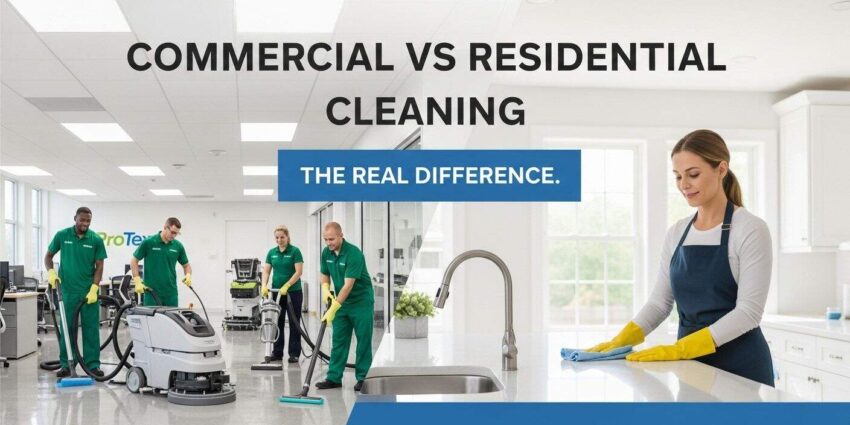
When it comes to maintaining spotless spaces, not all cleaning services are created equal. The difference between commercial and residential cleaning extends far beyond square footage—it encompasses specialized equipment, rigorous standards, and industry-specific protocols that fundamentally shape how professional cleaning companies approach each environment.
Understanding these distinctions isn’t just about choosing the right cleaning service; it’s about recognizing why commercial cleaning demands a level of expertise and precision that goes well beyond what’s required in residential settings. For business owners across Northern Idaho and Spokane, this knowledge can mean the difference between a facility that merely looks clean and one that meets stringent health, safety, and compliance standards.
Rich Greco, owner of ProTex Janitorial Services, has spent years perfecting both residential and commercial cleaning approaches throughout the Inland Northwest. “The biggest misconception I encounter is that cleaning is cleaning—that what works in a home will work in a commercial facility,” Greco explains. “But commercial cleaning involves layers of complexity that most people never see: compliance documentation, specialized training, industry certifications, and equipment that can cost tens of thousands of dollars.”
Key Takeaways
- Commercial cleaning requires specialized equipment and training far beyond residential capabilities, including HEPA filtration vacuums, autoscrubber floor machines, and EPA-registered disinfectants that meet specific log reduction targets
- Regulatory compliance distinguishes commercial from residential cleaning—businesses must adhere to OSHA standards, maintain SDS sheets, follow HIPAA-aware protocols in medical facilities, and implement HACCP procedures in food service environments
- The scope of work differs dramatically: commercial cleaning covers thousands of square feet with documented service level agreements, while residential cleaning focuses on personalized, home-specific tasks like appliance interiors and laundry add-ons
- Commercial cleaners undergo rigorous background checks, bonding, and insurance requirements that residential cleaners may not need, ensuring businesses receive vetted, accountable professionals
- Pricing models vary significantly—commercial services typically use square foot pricing models or flat rate contracts with clearly defined KPI scorecards, while residential services often charge hourly rates with flexible, customized packages
- Industry-specific cleaning protocols cannot be substituted: what works for office cleaning won’t meet the standards for medical offices in Spokane or manufacturing plants in Northern Idaho
Commercial vs Residential Cleaning: At A Glance
🏢Commercial Cleaning
🏠Residential Cleaning
Understanding the Fundamental Differences Between Commercial and Residential Cleaning
What Defines Commercial Cleaning Services?
Commercial cleaning services focus exclusively on business environments, ranging from small office spaces to sprawling industrial facilities. Unlike residential cleaning, which adapts to personal preferences and household routines, commercial cleaning operates under strict service level agreements that define scope of work, frequency of cleaning, and quality assurance programs.
The world of cleaning becomes significantly more complex when you step into commercial spaces. These environments demand:
- Standard operating procedures documented for every task
- ISSA CIMS certification and potentially CIMS GB (Green Building) accreditation
- GBAC STAR accreditation for facilities requiring advanced disinfection protocols
- IICRC standards for carpet and upholstery care
- EPA List N disinfectants proven effective against specific pathogens
Commercial cleaning companies must navigate multiple regulatory frameworks simultaneously. Manufacturing production facilities require adherence to OSHA compliance standards, while medical facilities demand HIPAA-aware cleaning protocols that protect patient information. Food service facilities need food-safe sanitizers and HACCP procedures that prevent cross-contamination.
“When we take on a new commercial client, we’re not just showing up with cleaning supplies,” says Greco. “We’re implementing a comprehensive quality assurance program with inspection checklists, digital work orders, client portal reporting, and KPI scorecards that track our performance against measurable standards.”
What Characterizes Residential Cleaning Services?
Residential cleaning services focus on homes, apartments, and personal living spaces where the priorities center on personalized care, flexibility, and attention to individual preferences. While professional cleaning standards still apply, residential cleaning offers a different value proposition than commercial work.
Key characteristics of residential cleaning include:
- Personalized homeowner checklists that adapt to specific family needs
- Flexible scheduling that works around personal routines
- Tidy vs deep clean scope options depending on current needs
- Appliance interior add-ons like oven and refrigerator cleaning
- Laundry and linens add-ons not typically found in commercial contracts
- Decluttering preparation assistance for homeowners
Residential cleaners often develop long-term relationships with clients, learning preferences for fragrance-free options, pet-safe cleaning solutions, and child-safe products. The approach emphasizes creating comfortable, healthy home environments rather than meeting industry-specific regulatory requirements.
In Spokane Valley residential cleaning and Coeur d’Alene residential cleaning markets, homeowners increasingly seek eco-friendly practices combined with subscription-based services that provide consistent care. Unlike commercial cleaning, residential services rarely require the extensive background-checked staff protocols, bonded and insured verification, or worker training curriculum mandatory in business settings.
Key Differences Between Commercial and Residential Cleaning
Scope and Scale: Size Matters More Than You Think
The scope of work represents one of the most obvious yet significant differences between residential and commercial cleaning. While a typical home might range from 1,500 to 3,500 square feet, commercial buildings regularly exceed 10,000 square feet, with some facilities spanning hundreds of thousands of square feet across multiple floors.
This dramatic difference in scale affects everything:
Commercial Cleaning Scope:
- Multiple restrooms requiring restroom sanitation checklists and touchpoint list creation
- Conference rooms needing rapid conference room turnover between meetings
- Break rooms with breakroom sanitation and microwave and fridge cleaning protocols
- Lobbies and entrance areas where pathway and lobby priorities create critical first impressions
- Elevator and handrail care for high-traffic vertical transportation
- Entrance mat maintenance crucial for tracking control
Residential Cleaning Scope:
- Personal bathrooms with toilet seat hinge cleaning attention to detail
- Kitchen cleaning focused on family meal preparation areas
- Bedroom and living area dusting and vacuuming
- Window cleaning at ground level or low heights
- Laundry room and utility space care
Commercial spaces also involve industry-specific cleaning requirements. Retail stores in Coeur d’Alene need retail fitting room standards, while educational facilities require school and campus cleaning protocols that address unique challenges like cafeteria sanitation and gymnasium floor maintenance.
Equipment and Cleaning Technology: Professional-Grade vs. Consumer Products
Perhaps no difference between commercial and residential cleaning is more striking than the cleaning equipment required for each. Residential cleaning typically relies on consumer-grade tools available at any home improvement store, while commercial cleaning equipment represents substantial capital investments requiring specialized training and equipment maintenance logs.
Equipment Investment: Commercial vs Residential
Average equipment costs reveal the professional-grade difference
🏢 Commercial Equipment
🏠 Residential Equipment
Commercial Cleaning Equipment:
- HEPA filtration vacuums and ULPA filtration systems that capture 99.97% of particles
- Backpack vacuums that increase productivity in large commercial spaces
- Autoscrubber floor machines for efficient hard surface cleaning
- Orbital floor scrubber technology for deep restoration
- Burnishing and polishing machines for high-gloss floor finish maintenance
- Strip and wax floors equipment requiring operator certification
- Carpet encapsulation systems and hot water extraction units
- Lift certified operators for high-reach window washing safety
Residential Cleaning Equipment:
- Standard upright or canister vacuums
- Mop and bucket systems
- Handheld dusters and microfiber cloths
- Consumer carpet cleaners for spot treatment
- Extension poles for ceiling fan dusting
- Basic window cleaning squeegees
“The equipment investment alone tells you something about the difference between these two worlds,” Greco notes. “A quality autoscrubber floor machine can cost $15,000 to $20,000. Our hot water extraction carpet cleaning system represents another major investment. These aren’t tools you’ll find in residential cleaning—they’re specialized service equipment designed for commercial applications.”
The technology extends beyond machinery to include dilution control systems and chemical dispensing stations that ensure proper concentration of cleaning solutions. Commercial cleaners must understand disinfectant vs sanitizer distinctions, contact time dwell time requirements, and log reduction targets that verify pathogen elimination.
Cleaning Standards and Regulatory Compliance
While both residential and commercial cleaners strive for cleanliness, commercial cleaning standards operate under regulatory frameworks that simply don’t apply to home cleaning. These standards protect workers, building occupants, and the general public through documented protocols and third-party verification.
Commercial Cleaning Compliance Requirements by Industry
Specialized protocols and certifications that distinguish professional commercial services
🏠 Residential Cleaning Requirements
No industry certifications required • No regulatory inspections • Flexible product choices
Focus on personal preferences, pet/child safety, and homeowner satisfaction
Critical Commercial Compliance Areas:
Health and Safety Regulations:
- OSHA compliance covering everything from ladder safety guidelines to slip trip fall prevention
- Hazard communication requirements including SDS sheets for all chemicals
- Bloodborne pathogens training for cleaning staff who might encounter bodily fluids
- Personal protective equipment specifications including nitrile gloves usage and eye protection standards
Industry-Specific Standards:
- HIPAA-aware cleaning in medical offices in Spokane
- Food-safe sanitizers and HACCP procedures in restaurants
- NSF certified products for food contact surfaces
- Cleanroom compatible methods and ISO class considerations for manufacturing
- Healthcare terminal cleaning protocols following CDC guidelines
Environmental Certifications:
- EPA Safer Choice certified products
- Green Seal GS-42 standards for commercial and institutional cleaners
- LEED EBOM cleaning credits contributing to building sustainability
- Green cleaning policy statements documented for stakeholder transparency
Quality Verification:
- Adenosine triphosphate (ATP) testing providing scientific cleanliness verification
- Quality assurance program inspections
- Inspection checklists completed for every cleaning session
- Before and after documentation proving service delivery
Residential cleaning rarely requires this level of documentation. While professional residential cleaners certainly use effective cleaning products and follow best practices, they don’t typically need compliance audit readiness or corrective action logs tracking performance issues.
Chemical Products and Cleaning Solutions
The cleaning products and cleaning solutions used in commercial versus residential settings differ substantially in formulation, concentration, and regulatory approval. Understanding these differences helps explain why commercial cleaners use products not available to consumers and why choosing the right cleaning service requires evaluating their chemical expertise.
Commercial Cleaning Products:
Commercial cleaning demands neutral pH cleaners that won’t damage expensive flooring materials, non-abrasive cleaners safe for delicate surfaces, and EPA List N disinfectants proven effective through rigorous testing. These products often come in concentrated form, requiring dilution control systems to ensure proper strength and cost-effectiveness.
Key commercial product categories include:
- Hospital-grade disinfectants with documented contact time dwell time specifications
- Color-coded microfiber systems preventing cross-contamination control between restroom and food service areas
- Fragrance-free options for environments serving chemically sensitive individuals
- Anti-slip treatments for high-traffic floor areas
- Specialty products for natural stone etch prevention and sealed wood floor care
- Stainless steel polishing compounds for commercial kitchens
- Electronics-safe dusting solutions for server room cleaning protocols
Residential Cleaning Products:
Residential cleaners typically use household cleaning tools and products that are:
- Pre-diluted and ready to use
- Available at retail stores
- Often fragranced for consumer appeal
- Pet-safe cleaning solutions and child-safe products for family homes
- Multi-surface cleaners with broader applications
- Eco-friendly practices incorporating natural ingredients
“In commercial cleaning, we’re not just making things look clean—we’re achieving measurable pathogen reduction,” Greco explains. “That’s why we use EPA-registered disinfectants with proven kill claims against specific organisms. In a residential setting, that level of antimicrobial efficacy usually isn’t necessary unless we’re doing post-illness disinfection.”
Commercial cleaners must also manage chemical inventory reduction initiatives, maintain spill response kits, follow incident reporting protocols, and ensure all staff complete hazard communication training. These requirements reflect the larger volumes, stronger concentrations, and greater risk potential of commercial cleaning products.
Training, Certification, and Staff Requirements
The professional cleaning service industry has evolved dramatically, with commercial cleaning companies now requiring extensive worker training curriculum that goes far beyond basic cleaning techniques. This professionalization distinguishes commercial services from residential services in fundamental ways.
Commercial Cleaner Training Requirements:
- Formal Onboarding Programs:
- Service onboarding checklist covering company policies
- Site survey and risk assessment training
- Standard operating procedures for every cleaning task
- Key control procedures and security badge protocols
- Electrical safety near equipment and chemical handling
- Specialized Certifications:
- ISSA CIMS certification coursework
- IICRC standards training for carpet and floor care
- GBAC fundamentals for infection prevention
- Lift certified operators training for aerial work
- Bloodborne pathogens training annual updates
- Industry-Specific Knowledge:
- Healthcare terminal cleaning protocols
- Server room cleaning protocol for IT environments
- Food-safe sanitizers application in restaurants
- Cleanroom compatible methods for manufacturing
- Historic building cleaning preservation techniques
- Quality Systems Training:
- Digital work orders and client portal reporting
- KPI scorecards interpretation
- Inspection checklists completion
- Corrective action log documentation
Background and Insurance Requirements:
Commercial cleaning services require background-checked staff for security reasons, especially when cleaning off-hours access periods. Staff must be:
- Bonded and insured with coverage limits appropriate to commercial risks
- Cleared through criminal background checks
- Documented with workers compensation coverage
- Trained on non-disclosure agreements protecting client confidentiality
- Supervised by certified site supervisor oversight
Residential Cleaner Training:
While professional residential cleaners certainly receive training, it typically focuses on:
- Home cleaning techniques and efficiency
- Customer service and communication
- Product knowledge for household supplies
- Time management for scheduled appointments
- Safety when working in occupied homes
The residential cleaning business model often emphasizes flexibility and personalization over standardized protocols, making extensive certification less critical than in commercial environments.
Commercial Cleaning vs Residential: Diving Deeper Into Specific Differences
Frequency and Scheduling: When Cleaning Happens
The frequency of cleaning differs dramatically between residential and commercial settings, driven by usage patterns, occupancy levels, and business requirements. Understanding these scheduling differences helps property managers and homeowners select the right cleaning service for their needs.
Commercial Cleaning Schedules:
Most commercial clients require regular cleaning on predictable schedules:
- Daily night cleaning crews for office buildings
- Day porter services providing continuous coverage during business hours
- Off-hours access cleaning to avoid disrupting operations
- Weekend-only cleaning for facilities with weekday-only operations
- Rotating task schedule completing deep cleaning on defined cycles
The occupancy-driven scheduling means cleaning must happen when it least interferes with business. Downtown Spokane office cleaning typically occurs between 6 PM and midnight, while retail stores in Coeur d’Alene might receive early morning cleaning before opening.
Commercial contracts also include periodic project work beyond routine maintenance:
- Quarterly deep cleaning of entire facilities
- Strip and wax floors annually or semi-annually
- Carpet encapsulation followed by annual hot water extraction
- Tile and grout restoration as needed
- Window washing on seasonal schedules
Residential Cleaning Schedules:
Homeowners enjoy much more flexible scheduling:
- Weekly, bi-weekly, or monthly regular cleaning appointments
- One-time deep clean services before events or after renovation
- Move in move out cleaning during transitions
- Seasonal cleaning plan adjustments for spring cleaning checklists
- As-needed services when life gets busy
The residential cleaning focuses on working around family schedules, often requiring daytime appointments when homeowners can be present or provide access. This contrasts sharply with commercial cleaning’s emphasis on minimal downtime strategies and off-hours access.
Pricing Models: How Services Are Valued
Understanding pricing differences between commercial and residential cleaning helps businesses and homeowners evaluate proposals and budget appropriately. The two cleaning service types use fundamentally different approaches to pricing.
How Pricing Models Differ: Commercial vs Residential
Understanding what you’re really paying for in each service type
Commercial Pricing
- All equipment & supplies provided
- Bonded & insured coverage
- Site supervisor oversight
- Quality assurance inspections
- Digital reporting & KPI tracking
- 24/7 emergency response
Residential Pricing
- Standard cleaning supplies
- Basic insurance coverage
- Flexible scheduling
- Personalized service
- Optional add-ons available
- Direct cleaner relationship
Why Commercial Costs More: The Value Breakdown
Commercial Cleaning Pricing:
Commercial cleaning companies typically use:
- Square foot pricing model based on facility size and cleaning frequency
- Per visit flat rate contracts specifying exact scope
- Service level agreements defining performance metrics
- Bundled service packages including routine and periodic work
- Hourly rate transparency for additional services
Pricing considers factors like:
- Total square footage requiring attention
- Frequency of cleaning (daily, weekly, etc.)
- Scope of work complexity and special requirements
- After-hours premium for night or weekend work
- Specialized equipment needed (floor machines, lift access)
- Industry requirements (healthcare terminal cleaning costs more than basic office work)
Commercial contracts often span one to three years with built-in escalation clauses, providing budget predictability for facilities managers. The pricing must account for worker training curriculum costs, insurance certificates on file, and site supervisor oversight.
Residential Cleaning Pricing:
Residential cleaning services commonly use:
- Hourly rate transparency charging by time spent
- Per visit flat rate for standardized packages
- Frequency-based pricing with discounts for regular service
- Room count or bedroom/bathroom based rates
- Customized quotes based on home size and condition
Residential pricing focuses on personalized homeowner checklists including:
- Tidy vs deep clean scope pricing differences
- Appliance interior add-ons like ovens and refrigerators
- Laundry and linens add-ons for additional services
- Decluttering preparation time when needed
- Specialty services like window washing or carpet cleaning
“The pricing conversation differs completely between commercial and residential,” Greco notes. “Commercial clients want documented scope changes, KPI scorecards, and corrective action logs. Residential clients want to know if we’ll clean inside the microwave and whether we bring our own supplies.”
Floor Care: Where the Rubber Meets the Road
Floor cleaning and maintenance represents perhaps the most technically demanding aspect of commercial cleaning, requiring expertise that far exceeds residential floor care capabilities. The difference between maintaining a home’s floors versus commercial space flooring illustrates why specialized cleaning knowledge matters.
Commercial Floor Care Programs:
Professional floor cleaning and refinishing services encompass multiple specialized processes:
- Hard Surface Maintenance:
- Autoscrubber floor machines for daily cleaning
- Burnishing and polishing creating high-gloss finishes
- Strip and wax floors restoration annually
- Floor finish maintenance preserving protective coatings
- Anti-slip treatments preventing slip trip fall hazards
- Grout line sanitizing in tile installations
- Carpet Maintenance:
- Commercial carpet cleaning programs
- Carpet encapsulation for interim maintenance
- Hot water extraction deep cleaning
- Bonnet cleaning for high-traffic area restoration
- Spot treatment protocol for immediate stain response
- Upholstery cleaning care for furniture and partitions
- Specialized Surface Care:
- Natural stone etch prevention for marble and granite
- Sealed wood floor care protecting expensive installations
- Concrete polishing in industrial spaces
- Terrazzo restoration in institutional buildings
- Resinous flooring maintenance in food processing
Commercial floors experience dramatically higher foot traffic than residential floors. A typical office building lobby might see thousands of impressions daily, while a home’s entryway handles dozens. This traffic differential demands professional cleaning equipment and specialized service knowledge.
Residential Floor Care:
Home floor maintenance remains much simpler:
- Regular vacuuming and mopping
- Periodic carpet cleaning with rented or consumer machines
- Occasional hardwood refinishing by specialized contractors
- Spot cleaning as spills occur
- Seasonal deep cleaning of tile and grout
The equipment and cleaning technology gap between commercial and residential floor care exemplifies why choosing between residential and commercial services matters. Commercial cleaners invest in battery management for tools, maintain equipment maintenance logs, and employ operators trained in complex machinery operation.
Window and Glass Cleaning: The View from Above
Exterior window and glass cleaning represents another area where commercial cleaning involves substantially greater complexity, risk, and regulation than residential work. The difference becomes apparent when considering multi-story buildings versus single-family homes.
Commercial Window Cleaning:
Professional commercial glass care requires:
- Lift certified operators for elevated access equipment
- Ladder safety guidelines compliance for OSHA
- Window washing safety protocols for high-rise work
- Rope descent systems (RDS) training for tall buildings
- Weather monitoring systems for outdoor work safety
- Building engineer coordination for roof and equipment access
- Liability insurance with elevated coverage limits
Large commercial buildings in Liberty Lake or Greater Spokane often feature:
- Windows inaccessible without specialized equipment
- Glass stretching dozens of stories high
- Interior atriums requiring scaffolding
- Skylights demanding roof access
- Delicate surface care for specialized glass coatings
Residential Window Cleaning:
Home window cleaning typically involves:
- Ground-level or ladder-accessible windows
- Basic extension poles for second-story access
- Standard squeegee and solution techniques
- Seasonal cleaning (spring and fall)
- Screen removal and cleaning
The risk profile and training requirements for commercial cleaning may include work at heights that would be completely outside the scope of residential cleaning services. This specialization explains why businesses need contractors specifically experienced in commercial clients work rather than residential providers.
Industry-Specific Requirements: No One-Size-Fits-All Solution
One of the most significant differences between commercial and residential cleaning lies in industry-specific cleaning protocols that cannot be substituted or simplified. What works in a general office building may be completely inappropriate or even dangerous in healthcare, food service, or manufacturing environments.
Healthcare Facility Cleaning:
Medical facilities in Spokane and Northern Idaho require:
- Healthcare terminal cleaning after every patient discharge
- High-touch disinfection of doorknobs, call buttons, and bed rails
- Contact time dwell time verification ensuring adequate disinfection
- Log reduction targets meeting CDC infection control standards
- Medical waste handling including sharps container protocol
- HIPAA-aware cleaning protecting patient information
- Color-coded microfiber preventing cross-contamination between zones
- ATP testing verifying cleaning effectiveness
Cleaning staff must understand bloodborne pathogens training and follow strict personal protective equipment protocols. The stakes couldn’t be higher—improper cleaning can literally cost lives through healthcare-associated infections.
Food Service Cleaning:
Restaurants and food service facilities demand:
- Food-safe sanitizers approved for food contact surfaces
- HACCP procedures preventing foodborne illness
- NSF certified products meeting food industry standards
- Cross-contamination control through proper workflow
- Restaurant back-of-house cleaning including kitchen hoods
- Grease trap maintenance coordination
- Floor slip resistance testing and treatment
- Pest prevention through sanitation excellence
“When we clean a restaurant kitchen, we’re not just removing visible soil—we’re implementing HACCP procedures that prevent foodborne illness,” Greco emphasizes. “Commercial cleaning often requires knowledge of food safety that has nothing to do with typical house cleaning skills.”
Manufacturing and Industrial Cleaning:
Manufacturing production facilities and industrial cleaning projects present unique challenges:
- Industrial plant housekeeping managing metal shavings, oils, and debris
- Warehouse floor maintenance for forklift traffic areas
- Cleanroom compatible methods and ISO class considerations
- Machinery cleaning around production equipment
- Dust collection systems maintenance
- Chemical compatibility with manufacturing processes
- Industrial facilities Spokane River corridor environmental compliance
These environments may involve hazardous waste handling, confined space entry procedures, and coordination with production schedules that demand minimal downtime strategies.
Educational Facilities:
Schools and universities in Spokane require:
- School and campus cleaning addressing high student traffic
- Gym and locker room hygiene preventing MRSA and staph
- Cafeteria sanitation following food service protocols
- Child-safe products in elementary schools
- Allergen awareness for student sensitivities
- Rapid turnover cleaning between class sessions
- Event cleanup services for assemblies and games
No residential cleaner develops expertise across these diverse types of cleaning. The specialization required underscores why businesses must partner with experienced commercial cleaning companies rather than attempting to use residential or commercial cleaning services interchangeably.
Regional Considerations: Northern Idaho and Spokane Cleaning Challenges
Unique Environmental Factors Affecting Cleaning Services
The Inland Northwest presents distinct cleaning challenges that both commercial and residential cleaning services must address. Understanding these regional factors helps property managers and homeowners select the right cleaning service equipped to handle local conditions.
Unique Cleaning Challenges: Northern Idaho & Spokane Region
Environmental factors requiring specialized cleaning expertise in the Inland Northwest
Winter Season
- Salt and sand tracking damage
- Ice melt chemical residue
- Snow-soaked entryway mats
- Increased floor maintenance
- Multiple daily lobby passes needed
Wildfire Season
- Fine particulate smoke residue
- Compromised indoor air quality
- Surface film on glass/furniture
- HVAC filter strain
- Increased cleaning frequency
Pollen Season
- Heavy pollen accumulation
- Allergy trigger concerns
- Window film buildup
- Entrance tracking issues
- HVAC system overload
Lakefront Zones
- Water and mud tracking
- Sand and grit accumulation
- Moisture control needs
- Mildew prevention
- Vacation rental turnover speed
ProTex Service Coverage: Inland Northwest
Seasonal Challenges in Northern Idaho and Spokane:
- Winter Salt and Sand Cleanup:
- Salt and grit removal preventing floor damage
- Snow season entryway maintenance managing tracked moisture
- Snow season floor care protecting finishes from deicing chemicals
- Entrance mat maintenance crucial during wet months
- Multiple daily passes in high-traffic lobbies
- Wildfire Smoke Residue Cleaning:
- Wildfire smoke residue cleaning removing fine particulate
- HEPA filtration vacuums capturing smoke particles
- Indoor air quality concerns during fire season
- Ventilation during cleaning balancing outdoor air quality
- Increased surface cleaning frequency during smoke events
- Seasonal Pollen Cleaning in Spokane:
- Seasonal pollen mitigation especially spring months
- Allergy-friendly cleaning techniques
- Filter replacement schedules for HVAC systems
- Window washing to remove pollen accumulation
- Entrance area focus preventing pollen tracking
- Lakefront Property Upkeep:
- Lakefront property upkeep managing water and mud tracking
- Coeur d’Alene lakefront homes cleaning specialized services
- Lakefront cabin cleaning services for vacation properties
- Moisture control and mildew prevention
- Dock and boathouse cleaning coordination
Industry-Specific Regional Services:
The Inland Northwest’s unique economy creates specialized cleaning demands:
- Resort and hospitality cleaning Coeur d’Alene for tourism properties
- Ski lodge cleaning Idaho with seasonal occupancy patterns
- Mining town cleaning services Wallace Idaho addressing industrial dust
- Historic building cleaning Spokane requiring preservation-appropriate methods
- Event venue cleaning Spokane for convention centers and banquet halls
- Vacation rentals Coeur d’Alene requiring rapid turnover cleaning
“Our region presents cleaning challenges you won’t find in many other markets,” Greco observes. “The combination of winter salt and sand cleanup, wildfire smoke residue, and our tourism economy means we need capabilities that go well beyond what cleaning companies in other regions might offer.”
Local Service Coverage and Market Dynamics
Understanding the geographic service areas and market dynamics helps businesses identify qualified providers. ProTex Janitorial Services maintains specialized expertise throughout:
Primary Commercial Service Areas:
- Northern Idaho cleaning services coverage
- Spokane commercial cleaning throughout the metro
- Coeur d’Alene janitorial services for business districts
- Post Falls office cleaning in growing commercial zones
- Sandpoint commercial cleaning serving northern Idaho
- Moscow Idaho cleaning company university and business sectors
- Lewiston janitorial service in the valley
- Spokane Valley residential cleaning and commercial coverage
- Liberty Lake commercial properties in development areas
- Bonners Ferry house cleaning extending to northern reaches
- Greater Spokane facility management coordination
- Kootenai County cleaning services comprehensive coverage
- Shoshone County janitorial solutions for mining region
The residential neighborhoods Post Falls to Wallace Idaho cleaning service corridor represents diverse property types requiring different cleaning techniques and service approaches. Urban Spokane downtown office cleaning demands differ substantially from Coeur d’Alene resort area cleaning or Kellogg janitorial cleaning in former mining communities.
Choosing the Right Cleaning Service for Your Needs
Assessment Framework: Commercial or Residential?
Selecting the right cleaning service begins with honest evaluation of your requirements. The decision between commercial and residential cleaning depends on several critical factors that go beyond simple property classification.
Do You Need Commercial or Residential Cleaning?
Answer these key questions to determine the right service for your needs
What is the primary use of your space?
Do you need cleaning outside business hours?
Are you subject to industry regulations or inspections?
Do you need documentation proving cleaning was completed?
What is your space size?
Scoring Your Results
Questions to Determine Your Needs:
- What is the primary use of the space?
- Business operations requiring off-hours access?
- Personal residence with family occupancy?
- Mixed-use property with both elements?
- What regulatory requirements apply?
- Industry certifications (ISSA CIMS, GBAC)?
- Health department inspections?
- OSHA compliance mandates?
- LEED EBOM cleaning credits goals?
- What documentation do you need?
- Service level agreements with defined metrics?
- Inspection checklists proving completion?
- Satisfaction surveys and reviews for stakeholders?
- Compliance audit readiness for regulations?
- What is your risk tolerance?
- Need for bonded and insured contractors?
- Background-checked staff requirements?
- Workers compensation coverage verification?
- Incident reporting protocol documentation?
- What is the scope and frequency?
- Daily cleaning during business hours (day porter services)?
- Night cleaning crews for uninterrupted operations?
- Weekly or bi-weekly home maintenance?
- Periodic project work beyond routine cleaning?
“The most important question isn’t ‘commercial or residential’—it’s ‘what outcomes do you need?'” Greco advises. “If you’re a small business owner thinking a residential service can handle your office because it’s only 2,000 square feet, you’re missing the bigger picture. Do you need documented scope changes? KPI scorecards? Compliance audit readiness? Those capabilities define commercial services regardless of square footage.”
Red Flags: When Providers Are Outside Their Expertise
Understanding the key differences between commercial and residential cleaning helps identify providers working outside their core competency. Watch for these warning signs:
Red Flags in Commercial Cleaning Providers:
- Cannot provide insurance certificates on file with adequate coverage
- No standard operating procedures documentation
- Lack of site supervisor oversight structure
- Unable to discuss quality assurance program specifics
- No worker training curriculum or certification records
- Cannot provide client references in your industry
- Unfamiliar with relevant regulations (OSHA, EPA, industry-specific)
- No digital work orders or client portal reporting capabilities
- Unable to conduct site survey and risk assessment professionally
- Unclear about equipment maintenance logs or tool inventories
Red Flags in Residential Cleaning Providers:
- Rigid policies unable to accommodate personalized homeowner checklists
- Cannot work during daytime hours for occupied homes
- Unfamiliar with pet-safe cleaning solutions or child-safe products
- No experience with appliance interior add-ons
- Unable to provide flexible frequency-based pricing
- Don’t offer decluttering preparation assistance
- Cannot accommodate special requests for fragrance-free options
The ProTex Approach: Bridging Both Worlds
While most cleaning companies specialize in either commercial or residential work, ProTex Janitorial Services maintains expertise across both domains—though with clear differentiation in how each service line operates. This dual capability provides valuable perspective on the genuine differences between these cleaning worlds.
ProTex Commercial Cleaning Excellence:
The commercial cleaning services ProTex delivers incorporate all the professional standards discussed throughout this article:
- Comprehensive quality assurance programs with measurable KPI scorecards
- ISSA CIMS certification and ongoing worker training curriculum
- Service level agreements defining exact scope of work
- Bonded and insured operations with background-checked staff
- Industry-specific expertise across office buildings, medical facilities, retail stores, manufacturing production, food service, educational facilities, and automotive industry clients
- Specialized equipment including HEPA filtration vacuums, autoscrubber floor machines, and hot water extraction systems
- Routine cleaning programs complemented by specialty cleaning services
- Regional expertise in Northern Idaho cleaning services and Spokane commercial cleaning
“We’ve built our reputation on understanding that commercial cleaning business success requires systems, training, and accountability that go far beyond what’s needed in residential work,” Greco explains. “Every commercial client receives digital work orders, client portal reporting, and inspection checklists that document exactly what we’ve done. That’s not micromanagement—it’s professional service delivery.”
Understanding When to Use Each Service Type:
The request estimate process begins with helping prospects understand which service type truly fits their needs. A small professional office might seem like a candidate for residential-style cleaning, but if it requires off-hours access, compliance documentation, or industry-specific protocols, commercial service is essential.
Conversely, homeowners occasionally inquire about commercial-level service for luxury residences. While ProTex can certainly bring commercial-grade equipment and expertise to high-end homes, most residential clients find the documentation, protocols, and pricing structure unnecessarily complex for personal living spaces.
Emerging Trends Affecting Both Commercial and Residential Cleaning
Technology Integration and Automation
The cleaning industry continues evolving rapidly, with cleaning technologies reshaping operations in both commercial and residential sectors. Understanding these trends helps property managers and homeowners make informed decisions about effective cleaning partnerships.
Commercial Technology Adoption:
- Cleaning Management Software:
- Digital work orders replacing paper checklists
- Client portal reporting providing real-time transparency
- GPS verification of crew arrivals and departures
- KPI scorecards tracking performance metrics automatically
- Corrective action log systems for immediate issue resolution
- Automation and Robotics:
- Robotic vacuum systems for large, open floor areas
- Autoscrubber floor machines with autonomous navigation
- UV-C disinfection robots for healthcare environments
- Sensor-driven restroom restocking programs
- Consumables inventory control through IoT sensors
- Quality Verification Technology:
- Adenosine triphosphate (ATP) testing for surface cleanliness
- Photo-verified completion through mobile apps
- Time-lapse cameras documenting overnight cleaning
- Electronic inspection checklists with timestamp verification
- Before and after documentation systems
Residential Technology Trends:
Home cleaning technology focuses on consumer convenience:
- Scheduling apps for booking and rescheduling
- Smart home integration for access control
- Online payment processing and invoicing
- Customer review and feedback systems
- Subscription management platforms
The gap between commercial cleaning equipment sophistication and residential tools continues widening as businesses invest in specialized service capabilities that provide competitive advantages and measurable ROI.
Sustainability and Green Cleaning Evolution
Green cleaning practices have moved from niche preference to mainstream expectation, though implementation differs substantially between commercial and residential cleaning services.
Commercial Green Cleaning Programs:
Businesses increasingly require documented environmental stewardship:
- Green Seal GS-42 certified products meeting strict standards
- EPA Safer Choice products minimizing environmental impact
- LEED EBOM cleaning credits contributing to building certification
- Green cleaning policy statements published for stakeholders
- Sustainability reporting quantifying environmental benefits
- Water usage reduction through microfiber systems
- Chemical inventory reduction minimizing product proliferation
- Reusable microfiber program eliminating disposable products
ProTex has observed that facility managers prioritize eco-friendly practices—the target audience research shows 60% rank sustainability highly. Commercial clients want green cleaning that delivers results without compromising cleaning standards or increasing costs significantly.
Residential Green Preferences:
Homeowners increasingly seek:
- Pet-safe cleaning solutions and child-safe products
- Fragrance-free options for sensitivities
- Natural ingredient formulations
- Reduced chemical exposure in living spaces
- Eco-friendly practices aligned with personal values
“The conversation around green cleaning differs completely between commercial and residential,” Greco notes. “Commercial clients want certifications and third-party verification. Residential clients want reassurance that products are safe around their kids and pets. Both are valid concerns, but they require different approaches.”
Post-Pandemic Cleaning Standards
The COVID-19 pandemic permanently elevated cleaning standards across both commercial and residential sectors, though implementation varies significantly.
Enhanced Commercial Protocols:
- High-touch disinfection focusing on frequent contact surfaces
- Contact time dwell time verification ensuring adequate disinfection
- Log reduction targets for specific pathogens
- GBAC STAR accreditation demonstrating infection prevention expertise
- EPA List N disinfectants with proven antiviral efficacy
- Electrostatic sprayers for comprehensive surface coverage
- Indoor air quality monitoring and improvement
- Increased frequency of cleaning in high-traffic areas
Many businesses maintain heightened protocols even as immediate pandemic concerns fade. Office cleaning standards now regularly include disinfection that would have been considered excessive pre-2020.
Residential Deep Cleaning:
Homeowners request enhanced services including:
- Post-illness disinfection after family sickness
- Increased frequency of cleaning during cold and flu season
- Allergy-friendly cleaning techniques
- Focus on high-touch surfaces like doorknobs and light switches
- Deep clean services more frequently than historically
The pandemic fundamentally changed how people think about professional cleaning, elevating its importance from aesthetic maintenance to health protection strategy.
Hybrid Work Impact on Commercial Cleaning
Hybrid and remote work models have dramatically affected commercial cleaning requirements, creating new challenges and opportunities.
Changing Office Cleaning Dynamics:
- Occupancy-driven scheduling matching cleaning to actual usage
- Flexible cleaning schedules accommodating variable attendance
- Reduced daily cleaning in partially occupied buildings
- Enhanced cleaning before high-occupancy days
- Touchpoint list creation focusing on actually-used areas
- Conference room turnover cleaning between hybrid meetings
- Breakroom sanitation adapted to reduced lunch traffic
“Hybrid work has completely changed the commercial cleaning conversation,” Greco observes. “Clients want flexibility to scale services up or down based on actual occupancy. The days of cleaning every desk every night are gone for many offices. Now we’re implementing occupancy-driven scheduling that matches cleaning to real usage patterns.”
This flexibility requires sophisticated cleaning management software, digital work orders systems, and client portal reporting that traditional flat-contract cleaning couldn’t accommodate. The commercial cleaning companies thriving in this environment offer customization that residential-style services have always provided but that commercial contracts historically avoided.
Making the Final Decision: Commercial vs Residential Cleaning
Cost-Benefit Analysis Framework
Understanding the true cost of commercial and residential cleaning requires looking beyond hourly rates to total value delivered. The difference between commercial cleaning and residential pricing reflects fundamentally different service propositions.
Commercial Cleaning Value Proposition:
When evaluating commercial cleaning costs, consider:
- Risk Mitigation Value:
- Bonded and insured protection against liability
- Background-checked staff reducing security concerns
- OSHA compliance preventing regulatory penalties
- Workers compensation coverage protecting your business
- Compliance audit readiness avoiding failed inspections
- Operational Efficiency:
- Off-hours access cleaning without disrupting business
- Day porter services maintaining appearance during operations
- Minimal downtime strategies keeping facilities operational
- Site supervisor oversight solving problems immediately
- Multi-site workflow standardization for chains
- Quality Assurance:
- KPI scorecards measuring performance objectively
- Inspection checklists documenting completion
- Corrective action log systems ensuring continuous improvement
- Client portal reporting providing transparency
- Satisfaction surveys and reviews gathering feedback
- Specialized Capabilities:
- Industry-specific cleaning expertise (healthcare, food service, manufacturing)
- Specialized equipment unavailable to general cleaners
- EPA-registered disinfectants meeting specific efficacy standards
- Green cleaning certifications supporting sustainability goals
- Emergency response cleaning for unexpected situations
The cost difference between a residential cleaner charging $25-35 per hour and a commercial cleaning service charging $35-50 per hour reflects these added capabilities and protections.
Residential Cleaning Value Proposition:
Home cleaning delivers different value:
- Personalized service adapting to family preferences
- Flexible scheduling around personal routines
- Trust and relationship with consistent cleaners
- Customized packages including appliance interior add-ons
- Lower insurance and bonding overhead costs
- Simpler frequency-based pricing without complex contracts
Questions to Ask Potential Cleaning Providers
Whether evaluating commercial or residential cleaning services, asking the right questions reveals provider capabilities and fit.
Essential Commercial Cleaning Questions:
- “What certifications and training does your staff complete?”
- Look for ISSA CIMS certification, bloodborne pathogens training, industry-specific credentials
- “Can you provide examples of your standard operating procedures?”
- Professional companies have documented SOPs for every task
- “How do you verify and document cleaning completion?”
- Expect digital work orders, inspection checklists, client portal reporting
- “What happens if we’re unsatisfied with service quality?”
- Quality providers have corrective action log systems and satisfaction guarantees
- “Do you have experience in our specific industry?”
- Medical facilities, food service, manufacturing each require unique expertise
- “What insurance coverage do you carry?”
- Request insurance certificates on file showing adequate limits
- “How do you handle security and access control?”
- Understand key control procedures, security badge protocols, off-hours access management
- “Can you accommodate our specific schedule requirements?”
- Discuss night cleaning crews, day porter services, flexible scheduling needs
Key Residential Cleaning Questions:
- “Are your cleaners background-checked?”
- Even residential services should screen employees
- “What’s included in your standard cleaning package?”
- Understand baseline vs. appliance interior add-ons and other extras
- “Do you provide cleaning supplies and equipment?”
- Most residential services do; verify what they use
- “Can you accommodate special requests like fragrance-free or pet-safe products?”
- Confirm flexibility for personalized homeowner checklists
- “What’s your cancellation and rescheduling policy?”
- Understand flexibility for frequency-based pricing adjustments
- “How do you ensure consistency if our regular cleaner is unavailable?”
- Learn about backup systems and training
When to Transition from Residential to Commercial Service
Growing businesses sometimes outgrow residential-style cleaning without realizing it. Signs you need to transition to commercial cleaning services include:
Transition Indicators:
- You need cleaning outside business hours
- Residential cleaners typically work daytime; businesses need night cleaning crews or off-hours access
- You face industry-specific regulations
- Healthcare, food service, or manufacturing requirements demand commercial cleaning standards
- You need documented proof of cleaning
- Audits, inspections, or certifications require inspection checklists and quality assurance programs
- Your space exceeds 5,000 square feet
- Larger facilities need commercial cleaning equipment like autoscrubber floor machines
- Multiple locations require standardization
- Multi-site workflow standardization needs standard operating procedures
- Liability concerns have increased
- Professional offices benefit from bonded and insured contractors with workers compensation coverage
- Cleaning affects your professional image
- First impressions matter for client-facing businesses
“I see businesses trying to make do with residential-style cleaning until they face a problem,” Greco explains. “Maybe a client visits and comments on cleanliness. Maybe they fail a health inspection. Maybe an employee gets hurt and they realize their ‘cleaner’ has no insurance. Don’t wait for problems—choosing the right cleaning service proactively prevents issues.”
Frequently Asked Questions About Commercial vs Residential Cleaning
What is the main difference between commercial and residential cleaning?
The fundamental difference lies in scope, standards, and specialization. Commercial cleaning requires documented protocols, industry-specific training, specialized equipment, and regulatory compliance that residential cleaning doesn’t need. Commercial services operate under service level agreements with measurable quality metrics, while residential services emphasize personalized care and flexible scheduling around family needs.
Can a residential cleaning company clean my small office?
While possible for very small spaces without regulatory requirements, most businesses benefit from commercial cleaning services even for modest square footage. Commercial cleaners provide bonded and insured protection, background-checked staff, off-hours access capability, and documentation that residential services typically don’t offer. The deciding factor isn’t size alone but your need for compliance, security, and professional accountability.
How much more expensive is commercial cleaning compared to residential?
Commercial cleaning typically costs 30-50% more per square foot than residential due to specialized equipment, extensive training, insurance requirements, and compliance documentation. However, commercial cleaning often occurs less frequently than residential (nightly or weekly vs. weekly or bi-weekly), and the total monthly cost reflects different service models. Commercial pricing includes capabilities like night cleaning crews, site supervisor oversight, and quality assurance programs that residential pricing doesn’t encompass.
Do I need special certifications for my cleaning company?
Commercial cleaning companies benefit significantly from certifications like ISSA CIMS, GBAC STAR accreditation, and IICRC standards that demonstrate professional competency and help win contracts. Industry-specific certifications become essential for healthcare, food service, or specialized facilities. Residential cleaning businesses rarely need formal certifications, though background checks and insurance remain important. The certification requirements reflect the higher stakes and regulatory complexity of commercial environments.
What equipment differences exist between commercial and residential cleaning?
Commercial cleaning equipment includes HEPA filtration vacuums, backpack vacuums, autoscrubber floor machines, burnishing and polishing equipment, hot water extraction systems, and lift access equipment costing tens of thousands of dollars. Residential cleaning relies on consumer-grade vacuums, mops, and handheld tools available at retail stores. Commercial equipment handles higher traffic volumes, larger square footage, and specialized surfaces that household tools cannot effectively maintain.
How do I know if I need commercial or residential cleaning services?
Evaluate your needs based on regulatory requirements, documentation needs, scheduling demands, and risk tolerance. If you need off-hours cleaning, industry-specific protocols, compliance documentation, or bonded and insured contractors, you need commercial services. If you’re maintaining a personal residence with flexible daytime scheduling and personalized service preferences, residential cleaning suffices. When in doubt, choosing commercial services provides more comprehensive protection and capabilities.
Are green cleaning practices different for commercial vs residential?
Both sectors embrace eco-friendly practices, but implementation differs substantially. Commercial green cleaning requires third-party certifications like Green Seal GS-42, EPA Safer Choice approval, and documentation for LEED credits and sustainability reporting. Residential green cleaning focuses on pet-safe and child-safe products, fragrance-free options, and natural ingredients without formal certification requirements. Commercial clients demand verified environmental performance; residential clients want reassurance about safety and values alignment.
What should I look for in a commercial cleaning contract?
Quality commercial cleaning contracts specify exact scope of work, frequency of cleaning, service level agreements with performance metrics, pricing terms, insurance requirements, key control procedures, and termination clauses. Look for contracts including inspection checklists, quality assurance programs, corrective action protocols, and client portal reporting access. The contract should address documented scope changes, communication escalation plans, and satisfaction survey processes ensuring accountability and continuous improvement throughout the partnership.
How often should commercial spaces be cleaned compared to homes?
Commercial spaces typically require more frequent cleaning due to higher occupancy and traffic. Office buildings often receive nightly cleaning, while retail stores might need daily or multiple daily services. Medical facilities require terminal cleaning after every patient, and restaurants need multiple daily cleanings. Residential homes typically schedule weekly, bi-weekly, or monthly cleaning based on family size and preferences. The frequency reflects usage intensity, regulatory requirements, and occupancy patterns rather than square footage alone.
Can the same cleaning company handle both my business and my home?
Some companies like ProTex Janitorial Services maintain expertise in both domains, though typically with separate teams and different operational approaches. The key is ensuring the company doesn’t apply residential methods to commercial needs or over-complicate residential service with unnecessary commercial protocols. Companies bridging both worlds should clearly differentiate their service delivery, maintaining commercial rigor for business clients while offering residential flexibility for homeowners.
Conclusion: Making the Right Choice for Your Cleaning Needs
The difference between commercial and residential cleaning extends far beyond the obvious distinctions in property type or square footage. These service categories represent fundamentally different approaches to professional cleaning, shaped by distinct regulatory environments, equipment requirements, training standards, and client expectations.
Commercial cleaning delivers systematized, documented, and specialized services that protect businesses from liability, ensure regulatory compliance, and maintain professional environments where first impressions matter. The investment in bonded and insured contractors, background-checked staff, specialized equipment, and industry-specific training reflects the higher stakes and greater complexity of business environments.
Residential cleaning offers personalized, flexible services that adapt to family preferences, accommodate daytime scheduling, and focus on creating comfortable home environments. The emphasis on relationship, customization, and household-appropriate care serves homeowners’ needs without the documentation and compliance burdens unnecessary in personal spaces.
“After three decades in this industry, I can tell you that the biggest mistake businesses make is underestimating what effective cleaning actually requires,” Greco reflects. “They think cleaning is cleaning—that anyone with a mop can handle it. But when you’re responsible for employee health, regulatory compliance, and professional reputation, you need professional cleaning services with the training, equipment, and systems that only experienced commercial cleaning companies provide.”
For businesses throughout Northern Idaho and Spokane, from Coeur d’Alene janitorial services to Post Falls office cleaning and beyond, selecting the right cleaning service means partnering with providers who understand your industry’s unique requirements. Whether you operate medical offices in Spokane, manufacturing plants in Northern Idaho, retail stores in Coeur d’Alene, or any other commercial facility, your cleaning partner should bring demonstrated expertise, proper certifications, and proven systems.
The investment in quality commercial cleaning services pays dividends through:
- Reduced employee sick days and improved employee health and productivity
- Enhanced professional image building trust and brand reputation
- Regulatory compliance avoiding costly violations
- Extended asset life through proper maintenance
- Peace of mind knowing trained professionals protect your investment
For homeowners seeking residential services, the right provider respects your home, accommodates your schedule, uses products safe for your family and pets, and builds trust through consistent, reliable service.
Understanding what the difference between commercial and residential cleaning truly encompasses empowers you to make informed decisions that protect your property, support your goals, and deliver value appropriate to your needs. Don’t settle for services that don’t align with your requirements—whether that’s commercial-grade protocols for your business or personalized care for your home.
Ready to experience the ProTex difference? Contact us to discuss your specific cleaning needs, or request an estimate to discover how professional cleaning services can transform your facility. Our team brings decades of experience serving commercial and residential clients throughout the Inland Northwest, delivering the expertise, equipment, and accountability your property deserves.
Whether you need routine cleaning, specialty cleaning, commercial carpet cleaning, floor cleaning and refinishing, window and glass cleaning, post-construction cleaning, or industrial cleaning services, ProTex Janitorial Services by Rich Greco delivers industry-leading standards that protect your investment and support your success.
The choice between commercial and residential cleaning services matters more than ever in today’s environment, where cleanliness directly impacts health, productivity, and reputation. Make the informed choice that serves your unique needs—and partner with professionals who understand the real differences between residential and commercial cleaning at every level.
About the Author: Rich Greco is the owner of ProTex Janitorial Services, bringing over three decades of professional cleaning expertise to businesses and homes throughout Northern Idaho and Spokane. His company specializes in commercial cleaning services across multiple industries, maintaining the highest standards in facility maintenance, regulatory compliance, and customer satisfaction. Learn more at protexjanitorialservices.com or read additional insights on the ProTex blog.